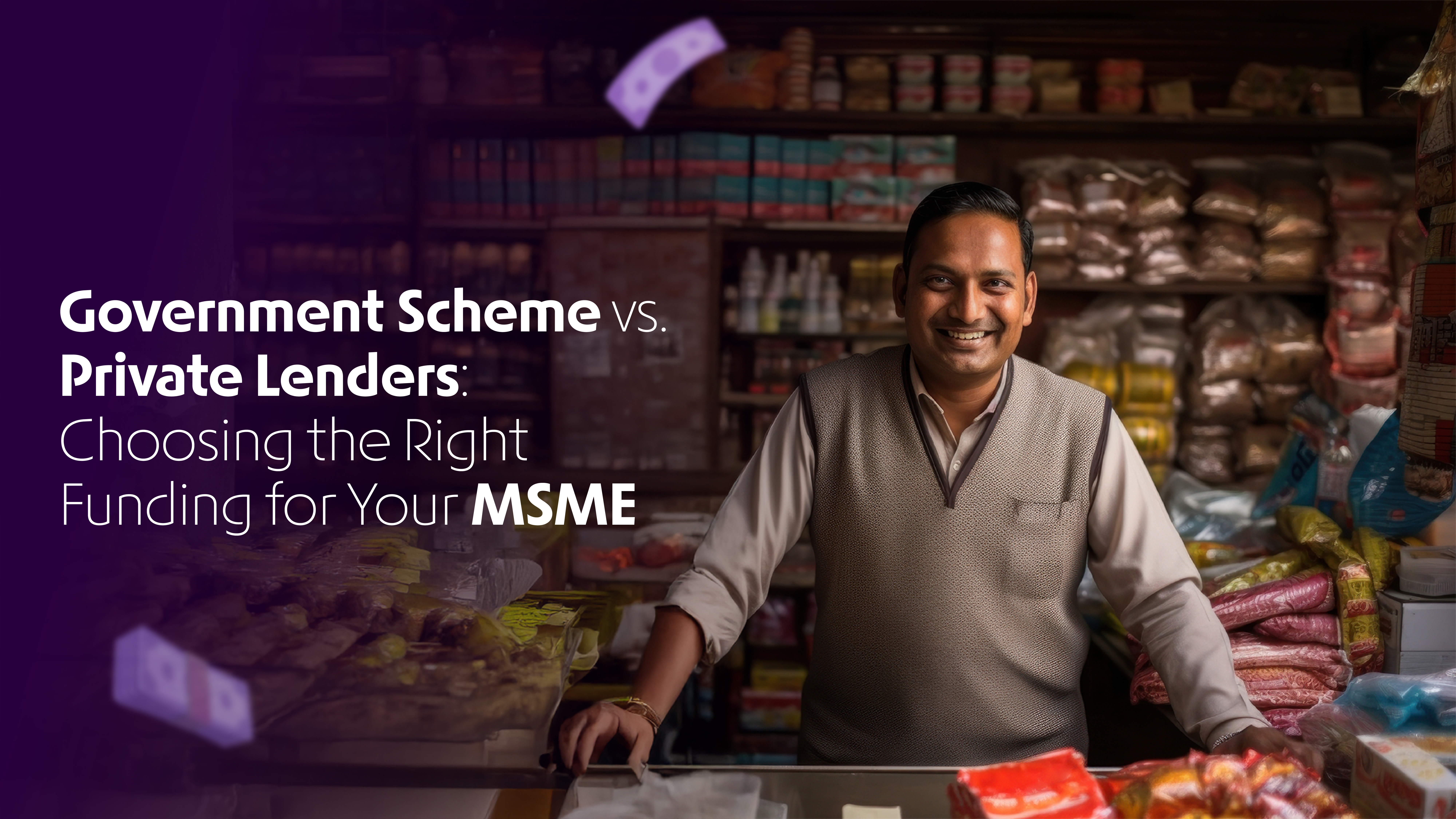
Access to timely funding is one of the most common challenges faced by MSMEs. Whether it is to manage day-to-day working capital, purchase equipment, or expand operations, businesses often reach a point where internal cash flows are not enough. At that stage, the question is not whether to borrow, but where to borrow from.
Broadly, MSMEs today have two main routes. One is government-backed schemes that are designed to make credit more affordable and accessible. The other is private lenders, including NBFCs and digital lending platforms, that focus on speed and flexibility. Each option serves a different purpose, and understanding the difference can help businesses avoid costly mifstakes.
This blog looks at how government schemes and private lenders compare, with a closer look at topics like Mudra loan vs private loan and CGTMSE scheme benefits, so MSMEs can make an informed choice.
Understanding Government Funding Options
Government-backed MSME loans are designed to address a long-standing problem: small businesses often struggle to access formal credit due to a lack of collateral, short operating history, or irregular cash flows. To solve this, several schemes work through banks and NBFCs to reduce the lender’s risk.
Two of the most widely used options are the Mudra loan and loans covered under the Credit Guarantee Fund Trust for Micro and Small Enterprises, commonly known as CGTMSE.
What Is a Mudra Loan?
A Mudra loan is aimed at micro and small businesses that need relatively small amounts of credit. These loans are typically categorised into Shishu, Kishor, and Tarun based on the loan amount. The idea is to support businesses at different stages, from early setup to gradual growth.
Mudra loans are usually offered by banks, regional rural banks, and some NBFCs. One key feature is that they are typically collateral-free, which makes them attractive to first-time borrowers and very small enterprises.
Understanding the CGTMSE Scheme
The CGTMSE scheme provides a credit guarantee to lenders, covering a significant portion of the loan amount in case the borrower defaults. This encourages banks and NBFCs to lend to MSMEs without requiring traditional collateral in many cases.
Among the major CGTMSE scheme benefits are easier access to higher loan amounts and improved chances of approval for businesses that are otherwise creditworthy but lack security. The guarantee coverage varies based on loan size and borrower category, but the core idea remains the same: reduce lender risk while supporting MSME credit flow.
Why Government Schemes Appeal to MSMEs
Government-backed loans often stand out because of their cost advantage and structured terms.
Lower cost of borrowing
Interest rates on Mudra loans and CGTMSE-backed loans are often lower than what most private lenders offer. Since part of the risk is absorbed by the government or guarantee trust, lenders can price these loans more conservatively.
For businesses that are sensitive to borrowing costs, this is one of the strongest reasons to explore government schemes.
Longer repayment tenures
Government-supported loans usually come with longer repayment periods. This reduces monthly repayment pressure and allows businesses to align loan outflows with their cash cycles.
Reduced collateral pressure
Collateral-free or limited-collateral lending is a major attraction. The CGTMSE scheme benefits especially apply here, as it enables businesses to access institutional credit without pledging personal or business assets.
The Limitations of Government-Backed Loans
While the advantages are clear, government schemes are not always the best fit for every situation.
Eligibility and documentation
Government schemes come with defined eligibility criteria. Businesses need proper registrations, financial records, and compliance documents. For very new businesses or those with informal accounting, this can become a hurdle.
Slower approval timelines
Processing times are often longer, especially when compared to private lenders. Applications move through structured checks and approvals, which may not suit urgent funding needs.
Limited flexibility
Once a loan is sanctioned, changes in terms, restructuring, or top-ups can sometimes be difficult. These loans are better suited for planned requirements rather than unexpected cash gaps.
How Private Lenders Approach MSME Funding
Private lenders operate with a different philosophy. Their focus is on speed, data-driven assessment, and convenience. This includes NBFCs, fintech platforms, and other non-bank institutions.
Faster access to funds
One of the key reasons MSMEs turn to private lenders is speed. Loan approvals can happen within days, sometimes even hours, depending on the lender and available data.
For businesses facing immediate cash flow pressure, this speed can be critical.
Capital should accelerate growth, not slow it down
Flexible assessment methods
Private lenders often rely on alternative data such as bank statements, GST filings, and transaction patterns instead of only traditional balance sheets. This helps businesses that may not qualify easily under government schemes.
Customised loan products
From short-term working capital loans to invoice financing and merchant cash advances, private lenders offer a wide range of products designed for specific business needs.
The Cost of Convenience
The advantages of private lending come at a price.
Higher interest rates
Private loans usually carry higher interest rates compared to government-backed options. This is because the lender takes on more risk without any guarantee support.
When comparing Mudra loan vs private loan, interest cost is often the most visible difference.
Shorter repayment cycles
Many private loans have shorter tenures, which increases monthly repayment obligations. Businesses need steady cash flows to manage this without stress.
Risk of cver-borrowing
Easy access can sometimes lead businesses to borrow more than necessary. Without careful planning, this can strain finances in the long run.
Government Schemes vs Private Lenders: A Practical Comparison
When MSMEs compare Mudra loan vs private loan, or evaluate CGTMSE scheme benefits against private funding, a few factors usually stand out.
Speed tends to favour private lenders, while cost favours government schemes. Documentation requirements are stricter under government-backed loans, whereas private lenders are more flexible. Government schemes are better suited for long-term needs, while private lenders work well for short-term or urgent requirements.
Understanding these differences helps businesses choose based on context rather than assumptions.
Choosing Based on Business Stage
Early-stage and first-time borrowers
For early-stage businesses, government schemes can be a good starting point if documentation and timelines are manageable. Mudra loans are especially relevant here due to their smaller ticket sizes and collateral-free nature.
However, if the business needs immediate funds to seize an opportunity or manage operations, a private loan may fill the gap.
Growing MSMEs
As businesses grow, funding needs become more frequent and varied. Many MSMEs combine both routes. A CGTMSE-backed loan may support expansion or asset purchase, while private credit handles working capital fluctuations.
The CGTMSE scheme benefits are particularly useful at this stage, as businesses may qualify for higher loan amounts without collateral.
Established businesses
More established MSMEs often use private lenders for agility and government schemes for cost efficiency. With stronger financial records, they can negotiate better terms on both sides.
Key Questions to Ask Before Borrowing
Before choosing between government schemes and private lenders, MSMEs should ask a few practical questions.
How urgent is the funding requirement? Can the business handle higher monthly repayments? Is the business eligible for a Mudra loan or CGTMSE-backed credit? Is the priority lower cost or faster access?
Clear answers to these questions often help identify the right funding option.
A Balanced Approach Works Best
For many MSMEs, the smartest strategy is not choosing one option over the other, but knowing when to use each. Government schemes provide stability and affordability. Private lenders provide speed and flexibility.
Understanding the real differences between Mudra loan vs private loan, and fully appreciating the CGTMSE scheme benefits, allows businesses to match funding choices with actual business needs rather than assumptions.
Conclusion
There is no single “best” funding option for MSMEs. The right choice depends on timing, purpose, and financial readiness. Government-backed loans work well for planned, long-term needs where cost matters most. Private lenders step in when speed and flexibility are critical.
By understanding how each option works, MSMEs can borrow with confidence and use credit as a growth tool rather than a financial burden.